for Businesses
How I Help You Choose Software
Finding the right software shouldn’t be overwhelming. Whether you need help evaluating a single tool or managing a complete digital transformation, I provide independent guidance tailored to your needs and budget.
From vendor selection and demos to contract negotiation and implementation planning, I’m here to make software procurement straightforward.
Practical Guidance for Frustrated Software Buyers
I help you cut through the noise of the software market. Instead of chasing the latest trends, we focus on finding and setting up the business software that actually solves your specific bottlenecks.
Book an Intro ChatFix Your Workflow
I find where your current tools (or lack of) are slowing you down and map out a simpler way for your team to get work done.
Pick the Right Tools
You tell me what you need, and I find the best-fit options for you and your team so you don't have to waste weeks on research.
Get the Best Deal
I can handle the vendor conversations and contract reviews to make sure you aren't overpaying or getting locked into bad terms.
Experience and Expertise
I have working knowledge across more than 300 categories of business software. My core expertise is in operations, sales management, HR, and business process management, though I regularly advise across other areas.
Common categories include:
● HR and people management: HRIS, ATS, performance management
● Project management: task management, portfolio management, resource planning
● Operations and sales: ERP, CRM, marketing automation, sales enablement,
ecommerce, accounting
Beyond software recommendations, I support the full procurement process – from initial research through to vendor selection, contract negotiation, and implementation planning.
Whether you’re a team of 5 or 500, the software buying process generally follows 5 steps:
The 5 steps of Software Buying
Step 1: Workflow Analysis
This is the very first part of the process where you identify the obstacles your team faces and what needs to be improved with software. There is either a complete lack of any tool in place or a system in place that isn’t working for whatever reason.
For many people, this is a very overwhelming process, especially if your sole job is not software buying. This is where you figure out your budget, timelines, and how urgently you need something in place – and often where you realize spreadsheets just aren’t cutting it anymore.
Step 2: Market Research
After identifying what category of software might fix an issue, people look to the market and try to understand how tools differ and unique product features. This could be a Google search looking for top lists, asking your favourite AI engine, or it could be watching Youtube videos, reading forums or speaking with colleagues about tools they have used.
Often this process combines all of these elements, it’s the part of the process people frequently find most overwhelming as there are many different tools on the market. Sometimes tools are only for certain industries, regions or company sizes.
Step 3: Vendor Demos
You’ve identified what category of software fits best and shortlisted a handful that stood out – maybe you like the layout, a friend recommended it, or you saw an ad.
People typically shortlist up to 10 tools and only demo several. This requires multiple stakeholders meeting with vendors and reviewing internally.
For larger companies, this can be time-consuming with multiple complex demonstrations. At this point, buyers verify the findings align with the initial obstacles from Step 1.
Step 4: Evaluation and Negotiation
At this stage, teams have typically gone through their research, and sat in multiple demos and might be deciding between 1 or 2 tools. This is the point when buyers see if the tools warrant spending and if it matches all their requirements. They might try to work out a deal with the software providers for a certain contract length, flexibility on price, or request customizations for niche cases.
As a rule of thumb, there is normally only leeway with large contracts on pricing, but often working with specialists they are able to get better deals. At the end of this stage a decision is normally made.
Step 5: Implementation
You’ve finalized your decision and are ready to move forward. This is where I’ve seen the most variation in timing. For the largest companies with complex requirements, people often go to specialists or pay a premium to implement faster. But for most companies that aren’t enterprise level, this is handled internally. For small teams, this could take a week; for mid-sized companies, around a month to get accustomed to the tool and begin customization to make it work perfectly.
Sometimes the IT department handles this, sometimes you work closely with the provider’s implementation teams, and sometimes you’re left to figure it out yourself. Either way, this can be more complicated than needed. Once figured out, the next step is training everyone on using it.
This process is typical for any company. While the time spent on each stage varies drastically, the journey is similar whether you are working solo or part of an enterprise organization.
Having advised over 2,000 businesses on their tech stacks, I have seen these same patterns repeat across nearly every industry. As an independent partner, my role is to remove the manual burden from this process. Here is how the Stack Champ method compares to the traditional approach for a typical mid-market company:
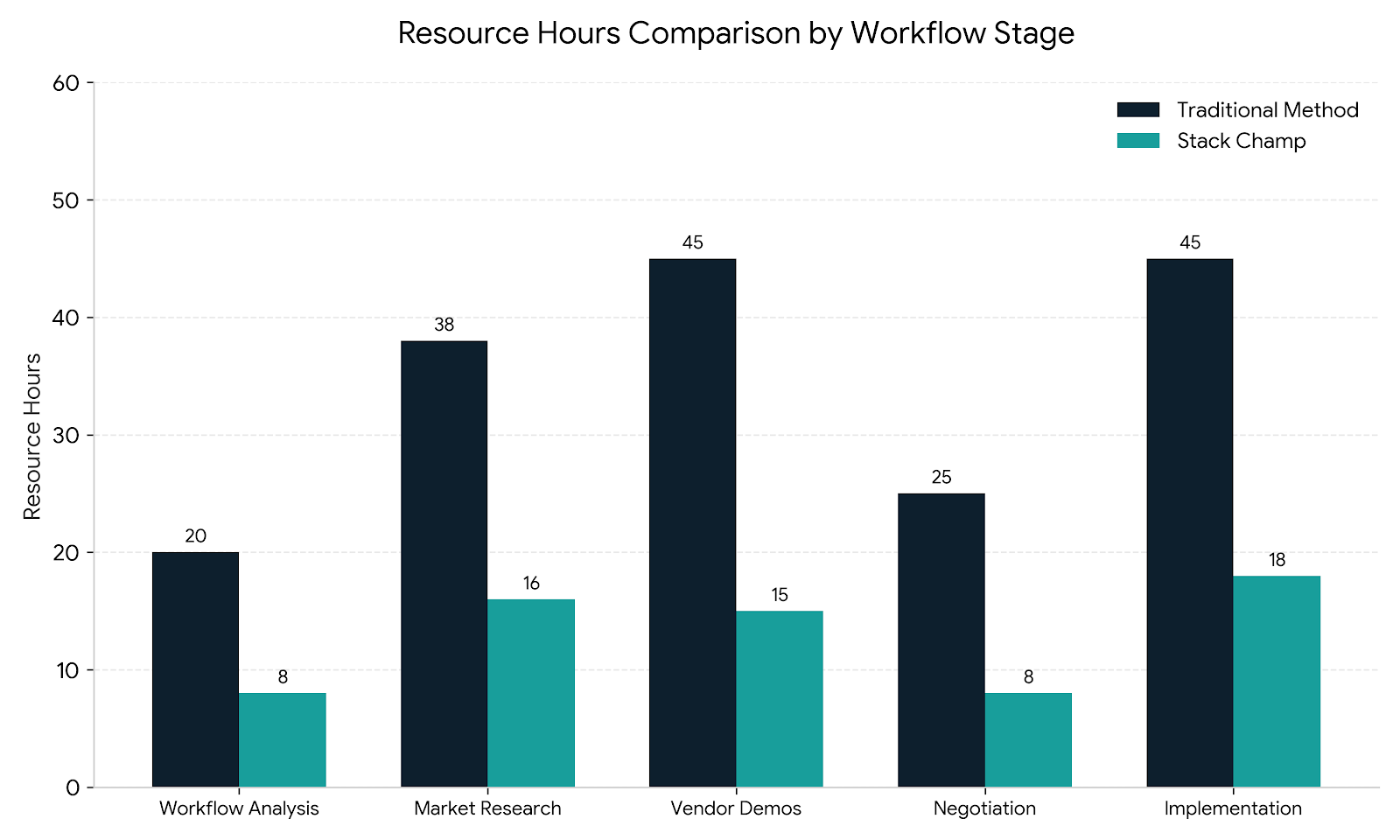
The Procurement Efficiency Gap: Traditional vs. Stack Champ
For mid-market organizations (200 – 500 employees), software procurement is often an uncoordinated manual burden.
The “Traditional Method” relies on fragmented communication and repetitive tasks that drain senior leadership time.
The Real Cost of Buying Software Alone
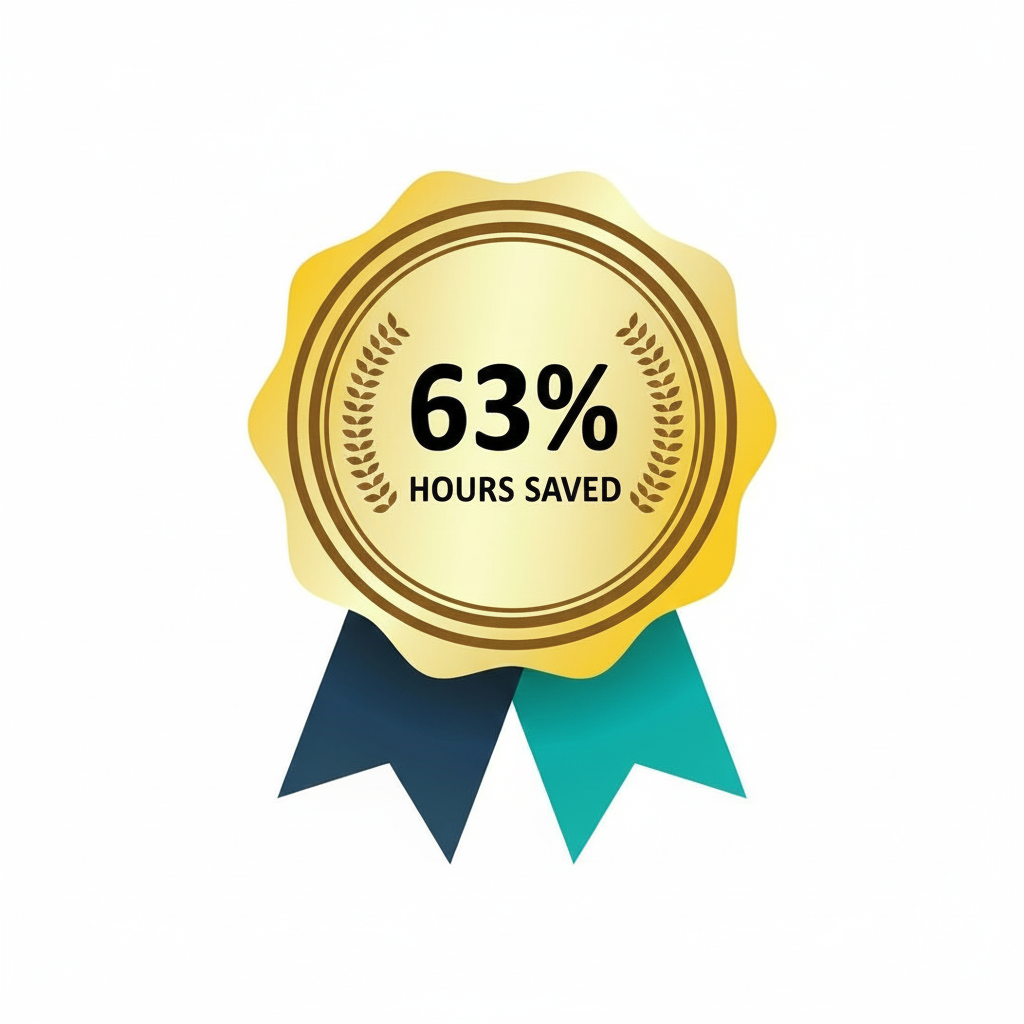
Finding the right software should be exciting, but for most teams, it ends up feeling like a second full-time job. For a company with 200 to 500 employees, the “traditional” way of buying software usually eats up over 170 hours of staff time. That is weeks of productivity lost to a process that often drags on for 3 to 6 months before a single person actually gets to use the tool.
Looking at the chart above, you can see where the time usually vanishes:
-
The Research Trap: Spending 40+ hours just trying to find out which vendors are actually worth talking to.
-
The Demo Loop: Sitting through 8 or more different vendor calls and then having to explain them all over again to the rest of the team.
-
The Implementation Lag: Spending another 45 hours trying to figure out how to actually set the tool up because the “pre-work” wasn’t done right.
Flexible Support
You choose the level of involvement that makes sense for your situation:
Looking back at those 5 steps, you might need help with all of them – or just a few. That’s why I offer three levels of involvement:
On Demand Advisor – Focused guidance for Steps 1 and 2 (Workflow Analysis and Market Research). Perfect if you want expert insights to get started but prefer to manage the rest of the process yourself.
Software Procurement & Advisory – Full support through Steps 1 – 4, from initial research through vendor demos and contract negotiation. You decide how hands-on you want me to be at each stage. Ideal for teams who want a partner guiding them through the buying process.
Digital Transformation Consulting – Comprehensive support across all 5 steps with full hands-on project management. Best for teams undergoing major operational changes who want a specialist handling the entire process for the fastest, smoothest possible outcome.
This type of flexible, comprehensive support is typically only available to large enterprises. I built Stack Champ to make it accessible to businesses of all sizes.
On-Demand Advisory
Focused guidance for teams researching software or refining their current stack.
Software Procurement & Advisory
Full support through your buying process, from shortlisting to contract negotiation.
Digital Transformation Consulting
Comprehensive support for businesses undergoing major operational change.
From Our Founder
Building a Tech Stack That Actually Works
I started Stack Champ because I saw too many businesses wasting months on software that didn’t actually solve their problems. Having helped over 2,000 businesses navigate these exact hurdles, I know that the ‘overwhelm’ usually comes from a lack of objective data and a clear process.
My goal isn’t just to hand you a list of tools. It is to give you the confidence that your technical stack is an asset to your growth rather than a drain on your time. I work independently because your efficiency is my only priority. There are no vendor kickbacks and no hidden agendas. You get straight answers every time.
Get In Touch
Crown House
27 Old Gloucester Street
London
WC1N 3AX
joe@stackchamp.com
 English